





Omega 3 foods you should include in your diet right now
The body doesn't make omega 3: it depends on what you eat. Discover the best foods rich in EPA and DHA, the vegan sources and when it makes sense to supplement.
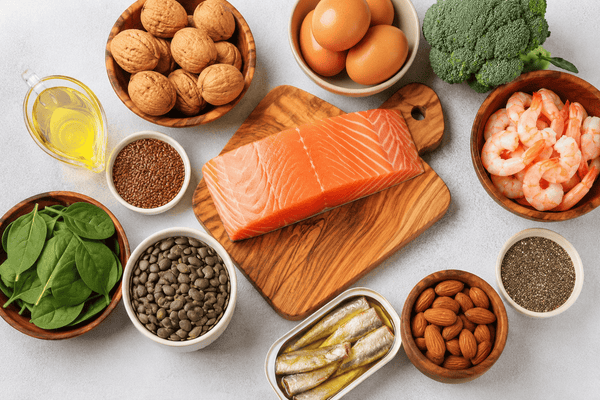
Table of contents
Most people consume omega-3 far below what their body needs and don't even know it. It's not an optional nutrient or a passing fad: omega 3 is one of the most solid pillars there is for cardiovascular health, cognitive performance and mood regulation. The problem is that the human body can't synthesise it on its own, so everything depends on what you put on your plate or how you decide to complement your diet.
In this article you'll find the most complete and efficient sources of omega-3, organised by type of fatty acid, bioavailability and consumer profile. No fluff and with the depth the topic deserves.
What omega 3 is and why it matters so much
Omega-3 isn't a single molecule. It's a family of long-chain polyunsaturated fatty acids, among which three main types stand out:
- ALA (alpha-linolenic acid): of plant origin, present in seeds and nuts. The body converts it into EPA and DHA, but with very low efficiency (between 5% and 15%).
- EPA (eicosapentaenoic acid): mainly of marine origin, it has a direct role in reducing inflammation and in cardiovascular health.
- DHA (docosahexaenoic acid): also of marine origin, it's the most important structural component of the brain and retina. Its presence is essential for cognitive function, memory and concentration.
This distinction is crucial because not all omega-3 foods are equal in terms of real benefit. Eating walnuts provides ALA, but if your goal is to protect brain health or reduce systemic inflammation, you also need EPA and DHA in relevant amounts. And that's where many diets, even well-planned ones, fall short.
When there is a sustained omega-3 deficiency over time, the effects go beyond fatigue or dry skin. There are direct consequences on concentration, mood and working memory. Understanding where these fats come from and how to incorporate them consistently is, in that sense, a smart decision.
The best omega-3-rich foods of animal origin
Animal sources of omega-3, especially oily fish, are the ones that provide the highest concentration of EPA and DHA per serving. There's no scientific debate about that. The key is choosing well and how often you eat them.
Oily fish, the most efficient source of omega-3
Wild salmon tops any serious list of omega-3-rich foods. A 100-gram serving can provide between 2 and 3 grams of combined EPA and DHA. Next come mackerel, sardines and herring, which are often underestimated for being less glamorous but turn out to be just as powerful and much more affordable.
Tuna, especially bluefin, is also a relevant source, although its omega-3 content varies a lot depending on the variety and presentation. Canned tuna preserved in water retains more EPA and DHA than the one preserved in vegetable oil, since the fish's fatty acids don't "dilute" in a neutral medium.
Fresh anchovies and canned anchovies are highly concentrated options usually eaten in small amounts, but in terms of nutritional density per gram they are among the most interesting in the Mediterranean diet.
Other animal foods that provide omega-3
| Food | Type of omega-3 | Approx. amount per 100 g |
|---|---|---|
| Wild salmon | EPA + DHA | 2,000 – 3,000 mg |
| Canned sardines (in water) | EPA + DHA | 1,400 – 1,800 mg |
| Mackerel | EPA + DHA | 2,200 – 2,500 mg |
| Fresh tuna | EPA + DHA | 1,000 – 1,500 mg |
| Oysters | EPA + DHA | 400 – 700 mg |
| Egg (enriched) | DHA (small amount) | 100 – 200 mg |
| Cod liver | EPA + DHA | 2,500 – 3,000 mg |
Omega-3-enriched eggs deserve a special mention. They come from hens fed with flax seeds or algae, and although they don't reach the concentrations of oily fish, they are a practical way to add DHA to the diet of those who don't eat fish often.
Discover ZZEN Labs' Omega-3
Vegan omega-3 sources for fish-free diets
One of the most common mistakes in plant-based diets is assuming that eating walnuts and chia seeds already covers omega-3. It's true they are valid sources of ALA, but as we've seen, the conversion of ALA into EPA and DHA is limited. This doesn't mean a vegan diet can't be compatible with good omega-3 levels, but that it requires more intention and knowledge.
Seeds and vegetable oils
Chia seeds are, gram for gram, one of the most concentrated plant sources of ALA. Two tablespoons (about 28 grams) provide approximately 5 grams of ALA. Ground flax seeds offer similar amounts, but it's important to eat them ground so the body can absorb their nutrients, since the whole shell makes them practically indigestible.
Walnuts are the exception in the world of nuts: they are the only relevant source of ALA in this group. A 30-gram handful provides around 2.5 grams of ALA. Almonds, hazelnuts or cashews, on the other hand, contain practically no omega-3.
Flaxseed oil is the most concentrated plant source of ALA there is, with close to 7 grams per tablespoon. It must be consumed cold, never for cooking, since heat oxidises it and makes it harmful.
Algae, the vegan exception for EPA and DHA
Marine algae are the only plant source that directly provides EPA and DHA in bioavailable form. Not ALA, but the same long-chain fatty acids found in oily fish. In fact, the omega-3 in fish comes precisely from the algae they consume in their food chain. Some types such as nori, wakame or spirulina contain modest but real amounts.
This is especially relevant for those following a vegan or vegetarian diet who want to ensure optimal DHA levels for the brain and nervous system. Algae-oil-based supplements have become the most studied and recommended alternative within plant-based nutrition.
How to get enough omega-3 through your daily diet
Knowing the foods is only half the way. The other half is knowing whether you're really eating enough consistently. The most recognised health guidelines recommend between 250 and 500 mg per day of combined EPA and DHA for healthy adults, although in contexts of chronic inflammation, cardiovascular health or cognitive performance, recommendations usually rise to 1,000 mg or more.
To reach those levels through diet, you'd need to eat oily fish about two or three times a week regularly. In practice, most people don't reach that frequency. And those following vegan diets, without the conscious inclusion of algae or supplements, rarely cover DHA requirements.
Factors that reduce omega-3 absorption
- An excess of omega-6 in the diet (present in refined vegetable oils such as sunflower or corn) competes directly with omega-3 for the same conversion enzymes.
- High consumption of trans fats interferes with the synthesis of EPA and DHA from ALA.
- Excessive heat during cooking oxidises polyunsaturated fatty acids and reduces their bioavailability.
- Age also plays a role: as we get older, the efficiency of ALA conversion decreases even further.
Tip: To improve the absorption of omega-3 from food, combine it with a small amount of additional healthy fat (such as extra virgin olive oil) and avoid cooking it at temperatures above 180 °C.
When it makes sense to supplement omega 3
There are situations in which, even if the diet is reasonably good, supplementing with high-purity omega-3 makes clear sense. Not as a substitute for good nutrition, but as a complement that guarantees consistency and an effective dose.
This applies especially if you eat fish less than twice a week, if you follow a vegan or vegetarian diet, if you have high triglyceride levels, if you want to optimise your cognitive performance or if you're in stages of high mental or physical demand. It's also relevant for older people, whose ALA conversion is less efficient, and for pregnant or breastfeeding women, in whom DHA demand multiplies.
The quality of the supplement matters as much as the dose. A high-purity omega-3 supplement with high concentrations of EPA and DHA, free of heavy metals and with good oxidative stability, makes a real difference compared to low-concentration products.
![[es] Suplemento Omega-3](http://zzenlabs.com/cdn/shop/files/01-Es_a19d3712-8713-447c-892d-144f0b1af417.png?v=1781970960&width=600)
Omega-3
27,90 € View Omega-3 →
At ZZEN Labs we develop supplements to this same standard, formulated with scientific criteria to support daily wellbeing with a complete, stable nutritional base.
Discover ZZEN Labs' high-purity Omega-3 supplement
Omega-3 and cognitive performance, the connection most often overlooked
There's a lot of talk about omega-3 in the cardiovascular context, but its role in the brain is equally powerful and, in many cases, more relevant to daily life. DHA makes up approximately 40% of the brain's polyunsaturated fatty acids and is a structural component of neuronal membranes. Without adequate levels, communication between neurons becomes less fluid.
The most solid neuroscience studies link an adequate DHA intake with better working memory, greater processing speed and a more balanced response to stress. In parallel, EPA has a modulating effect on neuronal inflammation, which is one of the underlying mechanisms in cognitive decline and mood disorders.
This makes omega-3-rich foods, and especially EPA and DHA, natural allies for those looking to maintain or improve their mental performance. It's not an immediate effect, but a cumulative one: the difference is noticed with weeks or months of consistent intake, not days.
If you're wondering whether you might already be noticing the consequences of an insufficient intake, there are signs of omega-3 deficiency worth knowing so you can act in time.
Conclusion: omega-3 foods are a long-term investment
Adding quality omega-3 sources to your diet isn't a one-off decision but a deep habit built with consistency. Oily fish remains the most direct and efficient way to get EPA and DHA in relevant amounts. Seeds, nuts and algae are valuable allies, especially in plant-based diets. And when diet doesn't cover real needs, a high-purity supplement closes the gap with no hassle.
Your brain, your heart and your cells will thank you in the long run. Omega 3 isn't an extra, it's a foundation.
Discover the Omega-3 supplement with EPA and DHA
Do you need help with anything?
If you have any questions about anything you've seen, please contact our friendly support team.
Chat nowUnlock your discount
Subscribe and get your exclusive discount code.


![[es] Pack suplementos Modo ZZEN](http://zzenlabs.com/cdn/shop/files/EsfromCastellano_1.png?v=1779288372&width=320)
![[es] Bote ZZEN Focus](http://zzenlabs.com/cdn/shop/files/Ingles01_1_3cc39391-b7c6-437c-a225-3e2599c2d82b.png?v=1778876969&width=320)
![[es] Bote ZZEN Sleep](http://zzenlabs.com/cdn/shop/files/Ingles01_3.png?v=1778877043&width=320)
![[es] Nootrópico ZZEN Calm](http://zzenlabs.com/cdn/shop/files/Ingles01_2_copy.png?v=1778877108&width=320)
![[es] Suplemento de magnesio](http://zzenlabs.com/cdn/shop/files/image_32efffc5-8b9f-410c-aa85-9b605d968109.png?v=1775459304&width=320)
![[es] Suplemento Omega-3](http://zzenlabs.com/cdn/shop/files/01-Es_a19d3712-8713-447c-892d-144f0b1af417.png?v=1781970960&width=320)


