

Creatine: what it's for, its benefits and how it works in the body
Creatine is one of the most studied supplements: how it works in muscle, which benefits are backed by evidence, how to take it and what to consider before adding it.
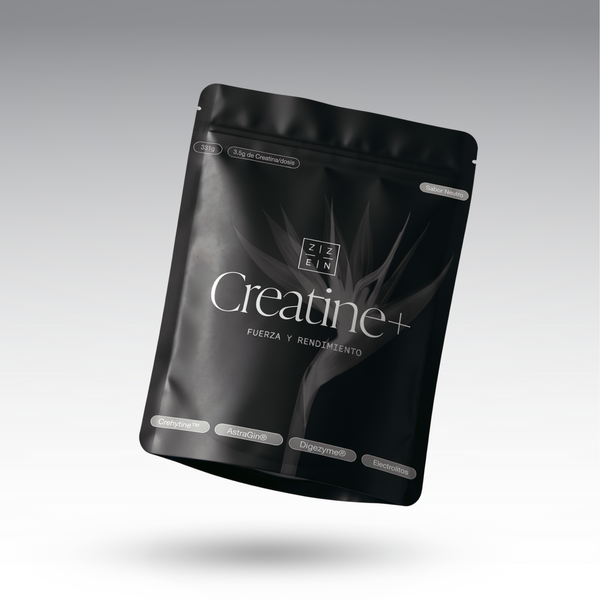
Table of contents
Creatine is one of the most studied supplements in sports nutrition. The body produces it naturally and uses it to have quick energy available, especially during short, intense efforts. That's why it's usually associated with strength training, sprints and other power sports.
Understanding what creatine is for helps separate what's backed by evidence from the promises that aren't. In this article we explain how it works, what benefits it can offer, how it's usually taken and what's worth considering before adding it to a routine.
What creatine is and why the body needs it
Creatine is a compound the body makes from amino acids. It's synthesised mainly in the liver and kidneys and stored, for the most part, in muscle. It's also present in foods such as meat and fish, although the amount obtained through the diet varies according to each person's habits.
Inside the muscle, a good part of creatine is found as phosphocreatine. This store takes part in regenerating adenosine triphosphate, better known as ATP, which cells use as an immediate source of energy.
Creatine isn't an anabolic steroid and shouldn't be confused with creatinine. The latter is a waste product measured in clinical tests to assess kidney function. Although their names are similar, they don't perform the same function.
How creatine works in muscle
During an explosive effort, such as lifting weights, sprinting or jumping, muscle uses up ATP quickly. As immediate stores are limited, phosphocreatine donates a phosphate group to ADP to form ATP again.
This energy system acts during the first few seconds of activity. When the demand continues, the body turns to other pathways, such as glycolysis and aerobic metabolism, which can sustain the effort for longer.
By increasing muscle creatine stores, supplementation can help sustain short, repeated high-intensity efforts better. In practice, some people manage to complete an extra rep, maintain power between sets or progress more consistently. The result also depends on training, rest, nutrition and individual response.
The best-supported benefits of creatine
Research on creatine has focused mainly on physical performance and strength training. These are the best-studied effects:
-
Performance in short, intense efforts. Creatine can improve performance in successive sets of high-intensity exercise, such as lifts, sprints or jumps.
-
Strength and power. By favouring the rapid availability of energy, it can help maintain the quality of your sets and support progression within a well-designed training programme.
-
Muscle mass gain. Creatine doesn't build muscle on its own. However, combined with strength training and adequate nutrition, it can allow a greater training volume and contribute indirectly to muscle adaptations.
-
Water inside the muscle cell. It's common to see a small initial increase in weight. This is usually due to greater water retention inside the muscle, not an increase in body fat.
-
Recovery and training continuity. Some studies look at its role in post-exercise recovery. The evidence doesn't allow it to be presented as a standalone solution, but it does support it as a help within a routine that includes rest, hydration and a reasonable training load.
Discover ZZEN Creatine+
Creatine monohydrate: the most studied form
Creatine monohydrate accounts for most of the available evidence. It's the usual reference in research and one of the most widely used forms thanks to its effectiveness, stability and good cost-to-result ratio.
There are other variants, such as creatine hydrochloride or creatine ethyl ester, but they haven't been consistently shown to offer better results than monohydrate. There are also differences in processing. Micronised creatine reduces particle size so it mixes more easily, while microencapsulation aims to improve practical aspects such as dispersion, stability or tolerance.
ZZEN Creatine+ uses microencapsulated creatine monohydrate and includes electrolytes, AstraGin® and DigeZyme®. Each serving provides 3.5 g of creatine and the directions for the product are one scoop a day, rest days included. Its neutral flavour means you can mix it with water or your usual drink.
How to take creatine monohydrate
Consistency is usually more important than the exact time you take it. Creatine works by progressively increasing muscle stores, so it's best to take it every day following the dose indicated on the product.
There are two common protocols:
-
Without a loading phase. This involves taking a stable daily dose. It's the simplest option and allows muscle stores to increase gradually, usually over several weeks.
-
With a loading phase. This uses a larger amount over a short period, split into several doses, and then moves to a maintenance dose. It can speed up the saturation of stores, but it isn't essential and may cause more digestive discomfort in some people.
You don't need to take creatine right before or after training for it to work. Choosing a moment that's easy to stick to is usually more useful than looking for the perfect time slot. If you notice digestive discomfort, it may help to take it with food or review the amount and how you prepare it.
In the case of ZZEN Creatine+, the current directions are one scoop a day, providing 3.5 g of creatine. It doesn't need a loading phase or cycles. Always follow the label instructions and consult a healthcare professional if you have a medical condition or take medication.
Comparison table of creatine monohydrate protocols
|
Protocol |
Initial dose |
Subsequent dose |
Approximate time to saturation |
Things to consider |
|
Without a loading phase |
3-5 g per day |
3-5 g per day |
Around 3-4 weeks |
Simple and easy to maintain |
|
With a loading phase |
About 20 g per day, split into 4 doses, for 5-7 days |
3-5 g per day |
Approximately one week |
May increase digestive discomfort |
|
ZZEN Creatine+ |
1 scoop per day, 3.5 g of creatine |
1 scoop per day |
Progressive with daily use |
No loading phase or cycles; follow the label |
These figures are general references, not a personalised regimen. The right amount can vary depending on the product, diet, body weight, type of training and a professional's judgement.
Creatine and cognitive performance: what we know
The brain also needs ATP and has its own phosphocreatine system. That's why researchers are studying whether supplementation can influence functions such as memory, attention or processing speed.
The results are interesting, but they aren't the same for everyone. The possible effects seem clearer in situations where stores may be lower or energy demand is higher, such as vegetarian or vegan diets, lack of sleep or highly demanding periods. In healthy, well-rested adults whose diet provides creatine, the effect may be more modest.
This field is still being studied. Creatine shouldn't be presented as a solution for memory or concentration problems, but as a compound with an energy role that is also being researched in brain tissue.
At ZZEN Labs we approach performance routines from both a physical and a mental perspective. In the case of creatine, the evidence on exercise is stronger than the evidence related to cognition, and that difference should be clear when assessing its possible benefits.
Creatine in older adults and other groups
The progressive loss of muscle mass and strength can affect mobility over the years. In older adults, creatine has mainly been studied together with strength training. The combination can support muscle adaptations, although exercise remains an essential part of the approach.
Varied responses have also been observed in women, vegetarians or vegans and athletes with different levels of experience. People who get little creatine from their diet may start from lower stores, but this doesn't make it possible to predict exactly how each person will respond.
Creatine is generally considered well tolerated in healthy adults when used in appropriate amounts. Even so, people with kidney disease, who are pregnant or breastfeeding, or who have pre-existing conditions or are under medical treatment should consult a healthcare professional before taking it.
Is it good to take creatine?
For many healthy adults who do strength training or high-intensity sports, creatine can be a useful supplement. That doesn't mean everyone needs it or that it replaces the basic pillars of performance.
Before deciding, it's worth considering three points:
Your goal. Its usefulness is best supported for strength, power and short, repeated efforts. In long endurance events, its effect is usually less direct.
Your routine. Without coherent training, enough rest and adequate nutrition, the room for improvement will be limited.
Consistency. Taking it irregularly makes it harder to keep muscle stores high. A simple regimen that fits into your day-to-day is usually preferable to a complex protocol.
It's also normal that not everyone notices the same change. Diet, initial stores, type of training and individual response all influence the result. If you have general questions about using supplements, you can check the ZZEN Labs FAQ.
Summary: what creatine is for
Creatine takes part in the rapid regeneration of ATP and helps provide energy during short, intense efforts. Its monohydrate form is the most studied, and its best-supported applications are in high-intensity performance, strength and supporting training adaptations.
It isn't a shortcut and it doesn't have the same effect on everyone. It works best as part of a stable routine, with an adequate daily dose, training, rest and nutrition. The loading phase is optional and the time you take it matters less than consistency.
If you're looking for a daily formula with microencapsulated creatine monohydrate, electrolytes and a simple one-scoop-a-day regimen, you can see the full product page for ZZEN Creatine+.
Discover ZZEN Creatine+
Frequently asked questions
How long does creatine take to work?
Should you take creatine on rest days?
Does creatine make you retain water?
Do you need help with anything?
If you have any questions about anything you've seen, please contact our friendly support team.
Chat nowUnlock your discount
Subscribe and get your exclusive discount code.